




-

"Very nice Posters. The quality is amazing and we received it very quickly !"
-

"A shop to visit absolutely. Huge selection of posters. We spent more than an hour there !"
-

"Perfect to find gift. Price are very good. An they can frame and pack it on site"
About the Artist
Before the cabaret stage came the horse. Henri de Toulouse-Lautrec grew up around aristocratic equestrian culture, and his early artistic education included guidance from René Princeteau, a painter known for animal subjects. Horses gave him a demanding lesson in observation: a moving body could change its entire expression in an instant. That interest persisted beyond the Paris nightlife for which he became famous. In The Jockey, it returns as the central subject rather than background entertainment. A Henri de Toulouse-Lautrec art print of this scene reveals a fascination that began long before his advertising posters.
The Artwork
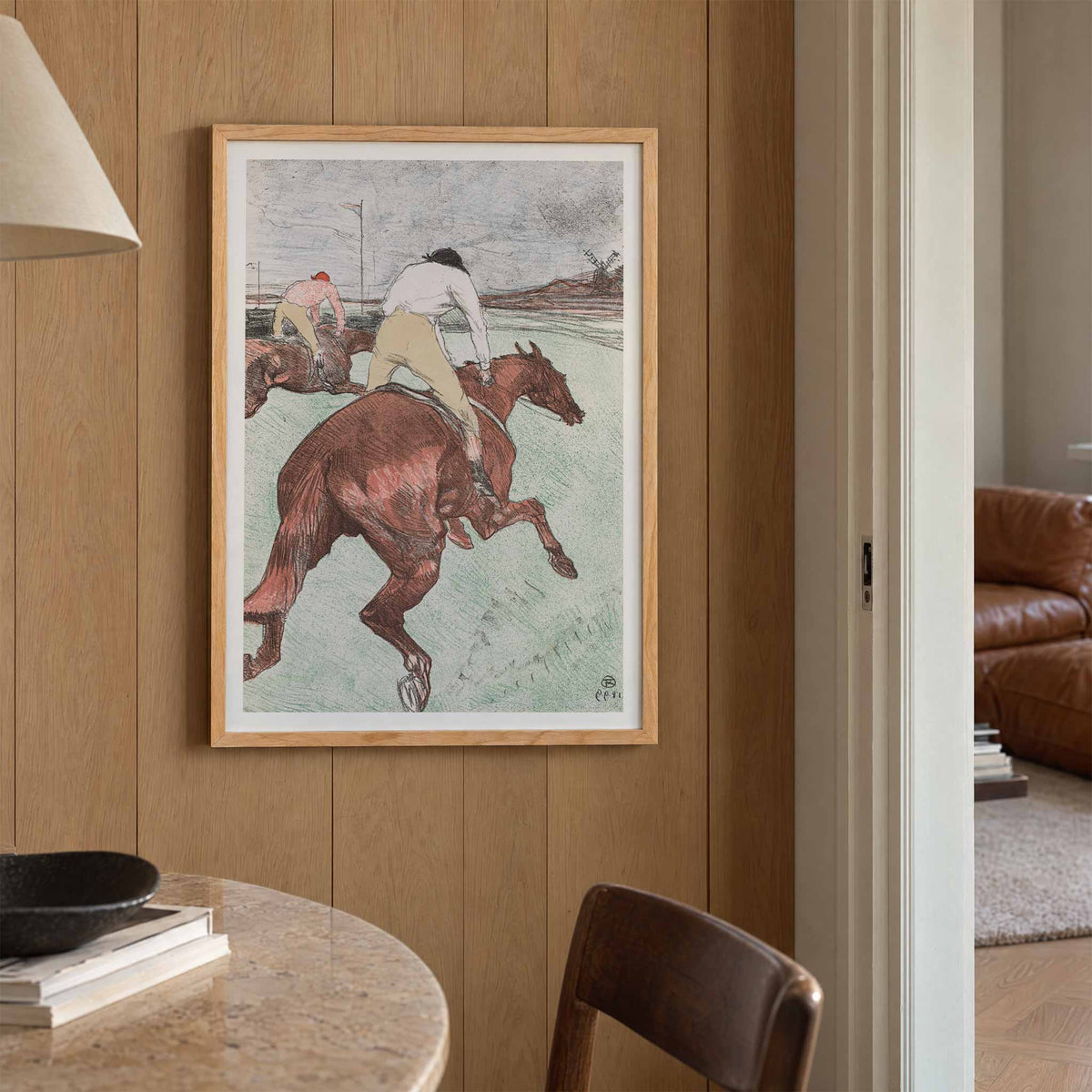
The racecourse offered another kind of theatre, one where anticipation could turn into excitement within seconds. The Jockey dates to 1899, when horse racing occupied an established place in French sporting culture. Toulouse-Lautrec approached the subject through lithography, returning to an early interest through a medium central to his career. Rather than promoting a named race meeting, the print takes racing itself as its subject. For a viewer choosing a vintage poster reproduction today, that distinction matters: this horse racing scene records an artistic preoccupation rather than a commercial invitation to attend an event.
Style & Characteristics
A chestnut horse bounds away from us, its broad hindquarters dominating the foreground. Above it, a rider in a pale shirt leans forward beneath a dark cap, while another jockey in pink rides farther left. Reddish strokes follow the nearest horse through its haunches and trailing tail. Pale green stretches beneath the lifted hooves, crossed by scattered marks that suggest disturbed turf. Beyond the riders, thin horizontal lines separate the course from a grey sky. In this Post-Impressionist fine art print, the close viewpoint makes the muscular effort of horse and rider almost tangible.
In Interior Design
Imagine a study in late afternoon, where sideways light reaches an oak desk and The Jockey hangs just above it in a narrow black frame. The pale green ground softens the wall behind the working surface, while the chestnut horse interrupts the stillness around the desk. Leave enough space around this vertical poster for its outstretched legs to register from the reading chair. As equestrian wall art, the image gives home decor a connection to racing without displaying sporting memorabilia. This vintage print reproduction can guide the interior decoration through a muted green repeated on the desk lamp.